Theta Data — Every Trade. Every Quote. Zero Filtering.
Intro
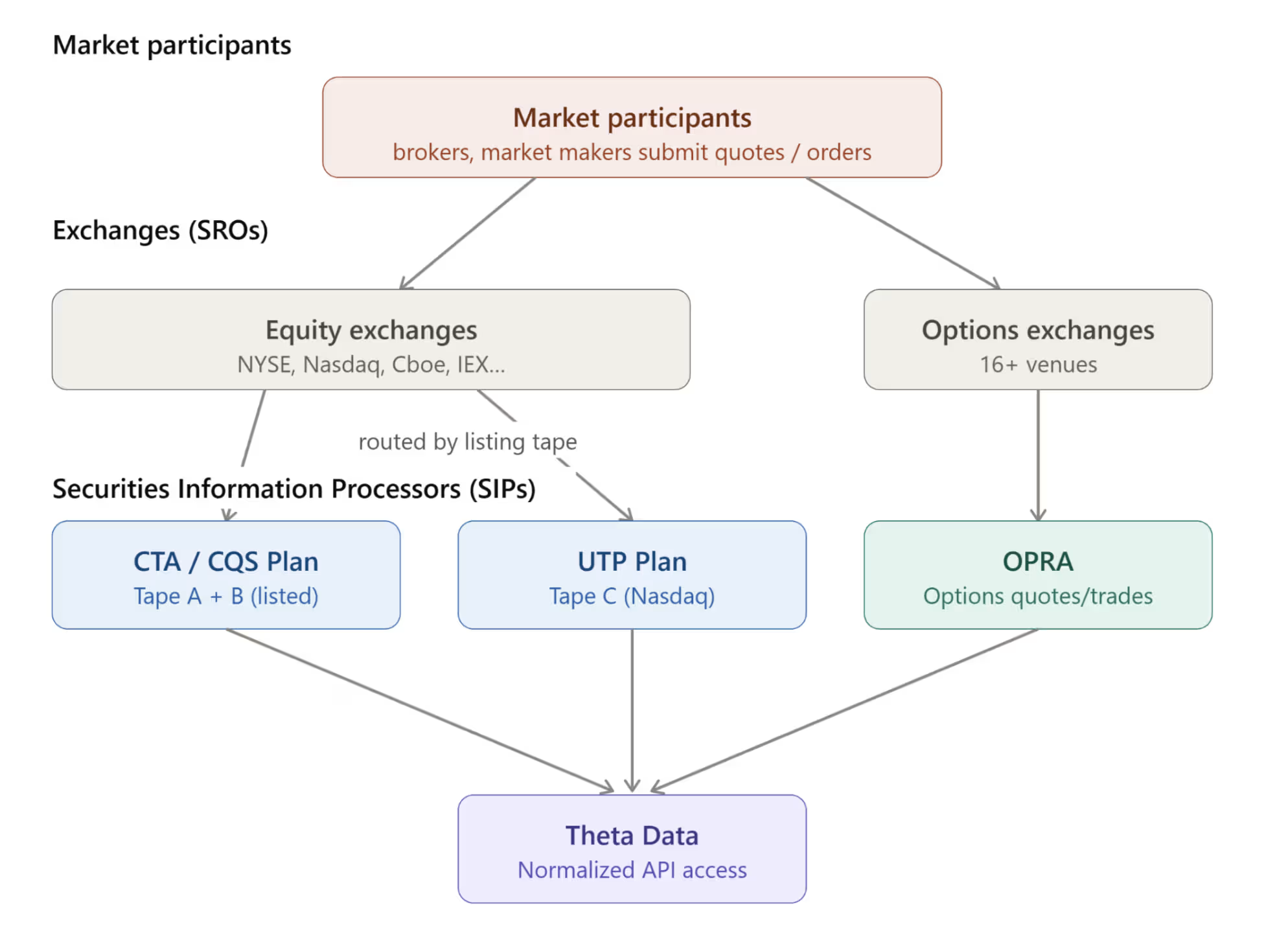
Prior to the creation and modernization of the Securities Information Processors (SIPs), price discovery was undemocratic, leaving those with the best proprietary exchange feeds with actionable advantages over other market participants. The U.S. Securities Information Processors (SIPs) trace their origins to the Securities Acts Amendments of 1975, in which Congress directed the SEC to facilitate a National Market System (NMS). Prior to this, quote and trade data were fragmented across exchanges with no consolidated view. The mandate led to the creation of consolidated data plans:
Consolidated Tape Association / Consolidated Quotation System (CTA / CQS)
- Administered by: NYSE
- Technology: Pillar (SIAC)
- Location: USLC/MAH Mahwah, New Jersey (primary), CH4 Chicago, Illinois (backup)
- Universe: US equity securities listed on NYSE / NYSE American (formerly known as AMEX)
Unlisted Trading Privileges (UTP)
- Administered by: Nasdaq
- Technology: Proprietary
- Location: NY11 Carteret, New Jersey (primary), CH2 Chicago, Illinois (backup)
- Universe: US equity securities listed on Nasdaq and OTC markets
Options Price Reporting Authority (OPRA)
- Administered by: CBOE
- Technology: Pillar (SIAC)
- Location: USLC/MAH Mahwah, New Jersey (primary), CH4 Chicago, Illinois (backup)
- Universe: All 18 US equity/index options exchanges
These plans operated as self-regulatory joint ventures among the exchanges, aggregating best bids and offers and last-sale data into a single consolidated feed, the SIP feed, that became the authoritative public reference for the national best bid and offer (NBBO). Governance sat with the participating exchanges, which both operated the processors and profited from selling the resulting market data.
History
In the early days, the SIPs had many flaws: lack of sub-second timestamp granularity, performance issues due to message throughput ceilings, and a lack of an executable National Best Bid and Offer (NBBO). Today, we take NBBO for granted, but prior to September 10, 2003, the date in which CTA began reporting NBBO, this was a luxury for the firms with the best technology and interpretation of data. All SIPs were eventually mandated to follow suit by Regulation NMS on August 29, 2005.
Regulation NMS was a catalyst for modernizing not just market data but the entire lifecycle of trading. It formalized the methodology for NBBO calculation, prevented trades from being executed on a price that wasn’t the NBBO (trade-through prohibition), and mandated distributed connectivity among exchanges and SIPs.
Recent News
Major changes to what the SIPs look like are coming. The SEC announced that the Consolidated Tape (CT) Plan will take the place of UTP/CTA in Q2 2027 and UTP and CTA will be dissolved. The purpose of the CT Plan is to streamline the technology, market data policies, and administration under a single SIP.
On June 11th, 2026 the SEC announced a proposition to rescind Regulation NMS Rules 611 and 610(e). If this proposition is enacted, it will remove the prohibition on trade-throughs and crossed markets. These rules were originally intended to protect less sophisticated market participants.
How a SIP works
The SEC requires exchanges to report some quotes (nuanced depending on the SIP) and trades data to the appropriate SIP. Each SIP has a publicly available binary input specification that is implemented by the participant exchanges themselves. Participants have cross-connects to the SIPs and publish messages using the TCP input specification.
When an exchange receives an order, it will make a determination whether the order is eligible to transmit to a SIP if it isn’t otherwise executed by its matching engine. For options exchanges reporting to OPRA, a quote will be transmitted to the SIP if the exchange’s own internal Best Bid and Offer (BBO) state changes for the security in question. OPRA will receive the quote and publish it to its binary multicast feed recipients. However, if the BBO quote update published by the exchange to OPRA changes OPRA’s NBBO state for the security, OPRA will transmit an NBBO quote message update to recipients. Most OPRA recipients elect to consume the NBBO-only messages as the per-exchange BBO message volume becomes challenging to store and process. Consuming full OPRA (per-exchange BBO) will incur message rates that are 3-5x the NBBO-only messages.
In addition to reporting NBBO, SIPs are responsible for reporting trades. When an order is executed on an exchange, the trade is reported by the exchange to the SIP. The SIP will turn around and publish that trade to its recipients.